Monday, April 22, 2019

Thankful for My Problems? (under construction)

On the basis of yesterday's post on learning to give thanks in everything, I'm now faced with the reality that my problems, short-comings, sin areas and failures come under the category of "everything," and I have to deal with how I'm going to give thanks for them.

Now my list of "impossible" problems looks like this:
1. Desire and ability to lead.
2. Consistency with life and disciplines
3. Developing an other's focus and a concern for others.
4. Discipline and control of eating.
5. Home church growth in depth and breadth.
6. Initiating in relationship with others.
7. Consistency with exercise.
8. Learning to suffer.
9. Making my Father my exceeding joy.

So, let's take the first one, desire and ability to lead. It has been said by many that "leadership is influence." If this is true then I do have a desire to lead in the sense that I do have some desire to influence others in how they think and in what they believe. However, what is fundamental to leadership that is lacking in my life is the the concept of taking responsibility for the lives of others. This is something that I do not naturally want to do. I am glad to help you and care for you when you ask for it, but I don't want to take responsibility for you. Whereas I do not have many brain cells that think in terms of being responsible for others, Sue does not have many that don't. She sees the people in the house as her responsibility and cannot sleep (literally) if they are not doing what they are supposed to be doing.

So how can I understand this in such a way to give thanks for this glaring shortcoming in my life?

I can

Thursday, April 18, 2019

Loyalty to Jesus (under construction)

Whatever is not from faith is sin.

Prideful thoughts - I'm better than others.  I'm not like others.

Wednesday, April 17, 2019

Going After What's Important

Blessed are the poor in spirit... Blessed are those that morn...Matthew 5:3, 4.

Jesus in the Sermon on the Mount begins to crush what we commonly think about the goal of life and what life is all about.  He has turned over not only the tables of those selling in the temple, but the tables of all of us who have set up our wares somewhere seeking prosperity in this life.  For many of us, life is about maximizing pleasure and ease and minimizing discomfort and inconvenience.  By contrast, Alexander Solzhenitsyn said, "The meaning of earthly existence lies, not as we have grown used to thinking, in prospering, but in the development of the soul."  We have to reorient ourselves to what Jesus says is important.  "Unless a grain of wheat falls to the ground and dies..." (John 12)  Watchman Nee says that the outer man (the soul - our minds, hearts, emotions) must be broken like the outer shell of a grain of wheat in order to allow the release of the spirit (and Spirit) within us.  Prosperity only pampers the outer man and makes the shell harder.  Prosperity only numbs and is a hindrance in the development and breaking of the soul.

By contrast, one of God's greatest gifts for the growth of the soul is suffering.  The testimony of so many who have embraced God's gift of suffering is that: 1) they wouldn't want to have to endure it again 2) they would not wish it on their worst enemy and 3) they would not trade the benefits of the experience for the world.  Spurgeon confirms:

“I am afraid that all the grace that I have got of my comfortable and easy times and happy hours, might almost lie on a penny. But the good that I have received from my sorrows, and pains, and griefs, is altogether incalculable … Affliction is the best bit of furniture in my house. It is the best book in a minister’s library.”

Let us not seek for that which prospers the outer man, but for that which prospers the soul, the inner man, and the spirit.

Monday, April 15, 2019

The Blessing of Sorrow and Suffering

Sorrow and suffering draw us to Jesus.
Sorrow and suffering humble us.  They bring about the breaking of our minds, hearts, and wills so that the spirit and the Spirit within us can be released.
Sorrow and suffering strengthen us.
Sorrow and suffering enable us to taste the sufferings of Jesus in an experiential way.
Sorrow and suffering pull us into an experience of the moment.

Seeing the "Why" in Our Suffering

"As for you, you meant evil against me, [but] God meant it for good in order to bring about this present result, to preserve many people alive. - Gen 50:20 NASB

Having good eyes in suffering is paramount.  Suffering that we see as needless, spiteful or unjust quickly turns to bitterness and/or anger. What man will not patiently wait two minutes on a traffic light to change at a busy intersection, but will angrily blow his horn if someone sits at a green light for more than a few seconds.   You may joyfully drive for hours to pick up a friend from the airport, but if your friend decides not to come, doesn't tell you and you make the trip for nothing, he may not be your friend anymore.

The reality is that in relationships there will be times when we suffer because of the ignorance, neglect, sin, selfishness, spite or abuse from others.  Joseph was sold into slavery by his brothers, which ultimately led to being framed and years in a dungeon.  Yet he endured without despair, bitterness or anger. Likewise, we must protect ourselves from the deadly diseases of despair, anger, and bitterness. As Joseph saw the hand of God in his affliction which caused him to rise above despair, anger, and bitterness, it is absolutely critical therefore that we see meaning and purpose in our suffering.  Navy SEALS undergo immense suffering and pain in their training.  Enormous physical exertion, days without sleep, exposure to miserable conditions ("cold, wet and sandy) all take there toll.  Though the training, preparation, and selection process have improved the success rate, in the past only 10 percent of those who start will finish.

How do the successful ones endure such hardship?  They know the "why" of their suffering; they are clear why they are there, why they are suffering, and why they must finish their course.

Suffering may clothe itself in listening to a long-winded friend, living daily in the grief of the loss of a child to a drunk driver, watching another receive credit for my work, or having to stay up late after an exhausting day to give attention to a spouse.

Do I know the "why" in my afflictions and am I ever holding it before me?  Without the "why", despair, bitterness, and anger are crouching at the door.

Wednesday, April 10, 2019

Enjoying People

And Levi gave a big reception for Him in his house, and there was a great crowd of tax collectors and other people [i.e., "sinners" - vs 30] who were reclining at the table with them. - Luk 5:29 NASB

When Jesus came to the place [where Zaccheus, a very rich tax collector had climbed up into a tree to see Jesus], Jesus looked up and said to him, "Zaccheus, hurry and come down, for today I must stay at your house." And he hurried and came down and received Him gladly. - Luk 19:5-6 NASB

It is apparent that the Lord Jesus enjoyed people.  And not just people, but individuals.  Tax collectors and sinners are street smart people who can size up others quickly, and who would have no patience or tolerance for a religious phony.  Jesus' popularity with the non-religious "fringe" people is certainly amazing, especially considering that "fringe" people are frequently that at the social margins because they have personality issues or have poor social skills that make them difficult to be around.

Do I really enjoy people?  This passage from Blue Like Jazz has often intrigued me.

So much of what I know about getting along with people I learned from the hippies. They were magical in community. People were drawn to them. They asked me what I loved, what I hated, how I felt about this and that, what sort of music made me angry or sad. They loved me like a good novel, like an art film, and this is how I felt when I was with them. I was never conscious of what my hands were doing or whether or not I sounded immature when I talked. I had always been so conscious of those things, but living with the hippies I forgot about myself. And when I lost this self-consciousness, I gained so much more. I gained an interest in people outside my own skin...

Do I enjoy individuals like a good book, find them fascinating, savor them like a glass of wine?  Three things are necessary for us to deeply enjoy people:

1. We can't be in a hurry.  We have to have time for people.  We can't be in the mode of "spit it out; I've got places to go and things to do."  Oswald Chambers said, "You can always recognize who has been through the fires of sorrow and received himself, and you know that you can go to him in your moment of trouble and find that he has plenty of time for you. But if a person has not been through the fires of sorrow, he is apt to be contemptuous, having no respect or time for you, only turning you away. If you will receive yourself in the fires of sorrow, God will make you nourishment for other people."

2.  We have to believe that there's gold in each person. “I have never met a man so ignorant that I couldn’t learn something from him,” said Galileo.  Each person has a story, an experience with God, things that we can glean. Are we willing to dig in, to sort through a 55-gallon drum of cow manure if necessary to find the gold?

3.  We have to have a childlike wonder and can't have a critical spirit.  We have to accept each person as if they perfectly who God wants them to be.  When we go to the zoo we don't think "That hippopotamus has an eating problem" or "What's the matter with Mr. Lion - where'd he get his anger issues and dominance problems?"  They just are. 

There's a place for helping people grow and learn, but if we don't work from a foundation of enjoying them for who they are, we are limited in how much we can help them grow.  People can smell when they are your project and you are playing God. 

Bless someone today by enjoying them - just as they are.

Tuesday, April 9, 2019

What is Your Gospel?

"According to my gospel...: Romans 2:16, 16:25, Titus 2:8

The gospel is good news on many fronts.  How is it good news to you?  What keeps you following Jesus?  How is the gospel personal to you?

The gospel is good news to me in three ways. Certainly, it is good news that we are going to heaven and not to hell.  If God never did anything else, this is truly good news enough. But here on this planet, in the context of life on this broken world where sin, suffering, and sorrow are the landscape on which we place our tent, there are three things that get me excited about Jesus and keep me pursuing God.

This is eternal life, that they may know you, and Jesus Christ whom you have sent.  John 17:3
First, he is with me in the brokenness of my days.  I have a relationship with him and there is nothing sweeter than his voice talking to me in his word, nothing more glorious than knowing I have experienced him in some way and nothing more awesome than knowing and having God as my Father.

And He has said to me, "My grace is sufficient for you, for power is perfected in weakness." Most gladly, therefore, I will rather boast about my weaknesses, so that the power of Christ may dwell in me. 2Co 12:9 NASB
Second, Christ gives me grace for love, suffering, and difficulty.  He does not take me out of my difficulties but gives grace and power in the context of my difficulties.

Jesus said to him, "I am the way, and the truth, and the life; no one comes to the Father but through Me." John 14:6 NASB
Third, Jesus explains reality.  He has answers, wisdom, insight into how to live.  He really is the Way, the Truth and the Life.   He explains why people are the way that they are, why sin is, why things are broken.  He helps me understand my purpose and why I exist on this planet. He makes sense of the chaos and maelstrom of life.

This is my gospel, my good news.  Please, tell me yours.

Sunday, April 7, 2019

The Fact of Suffering


In the world you have trouble and suffering... John 16:33 NET.

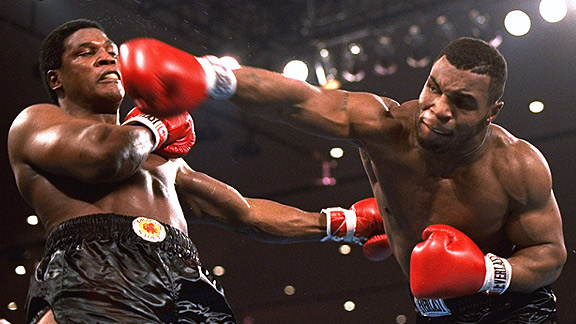
The successful prize fighter must encompass a three-pronged approach to winning. First, he must know how to score and successfully land blows onto his opponent in order to do this.  He must have and execute a winning offensive strategy.

Second, he must have a defensive strategy.  He must be able to defend himself against his opponent.  His adversary will be seeking to land blows to his body and face, and he must know how to fend these off, in order to protect himself and also to prevent him from scoring.

Image result for mike tyson training

Lastly, no strategy is perfect or perfectly executed.  Almost certainly, the opponent will land some blows, inflict some pain, and do some damage to him.  Therefore, he must learn to suffer.  As renowned boxing champion Mike Tyson famously said, "Everyone has a plan... until he gets punched in the face."  A person who cannot endure the pain and suffering of the fight cannot stay in the ring to win.  Can you imagine a boxer taking a hit in the stomach, turning to his coach and saying, "You didn't tell me THAT was going to happen!"  We can imagine the coach responding, "You're in a boxing match, you idiot!  What did you expect?"

Making relationships work is very similar.  First, we certainly want to do everything we can to do good in the relationship to make it work. We want to be blessing the other(s) with serving, with encouragement, with gifts, with instruction as appropriate, with a filial love.

Second, we want to address and resolve the problems that will naturally occur in any relationship.  We want to talk them out, do our best to find middle ground, work to understand, and try to iron out differences.

Lastly, though we give our best efforts to make the relationship successful, and work diligently to resolve problems in the relationship, inevitably there will be problems that we cannot resolve.  Inevitably, there will situations in a relationship where we are damaged or hurt by the "blows" from another, or where there is an impasse and we don't get what we want or believe that we deserve.  Then it boils down to the raw truth that in order for the relationship to continue, in order to "stay in the ring," we have to suffer.  We will have to suffer feeling unappreciated, unjustly treated, sinned against, violated, betrayed, belittled, abused, taken advantage of, lied to, cheated or cheated on, or unloved.  Can you imagine complaining to God, "Father, that person was so selfish and XXXed me (fill in any sin of your choice). You didn't tell me THAT was going to happen."  You can hear God responding, "You're in a relationship, you idiot!  What did you expect?"

This three-pronged approach also extends as a general statement about life.  We want to have winning strategies, be wise, and do the things that will cause things to go well for us. We want to solve our problems and eliminate the obstacles to our pursuit of good and success.  However, because we live in a fallen world, and because of the fact of sin, our porcelain plans will certainly at some point be dashed to the stone floor of reality, and there will be suffering.    In the middle of our greatest growth or plans or successes come the phone calls in the middle of the night, the sober talks with doctors, the blunt force trauma of an unfaithful spouse.  Veteran psychiatrist Scott Peck states that most people suffer mental illness because they cannot face the reality that life is hard.  "You're living in a broken world; what did you expect?"

Addressing the reality of suffering is the missing element in most self-help strategies. The Bible, however, acknowledges this truth, as it frequently discusses the reality of the afflictions or tribulations through which we must suffer and endure.  The word in the original language means pressure.  There will always be pressure, affliction, and stress through which we must suffer.

In every day and in every relationship we must plan and prepare for the reality of suffering.  Woe to him who is not prepared and cannot endure the left hook of life and right uppercut of relationships.

Friday, April 5, 2019

Love as Suffering


Above all, keep fervent in your love for one another, because love covers a multitude of sins. 1Pe 4:8 NASB

One "given" in relationships (and life) is that there will be problems with other people in relationships. We all see differently and have our own worldviews, beliefs, and values, which at best are still different from every other person on the planet.  There are also in relationships honest misunderstandings, and the ever-present reality of sin, without which no calculations regarding human behavior should be made. Therefore, in relationships, there will always be problems and difficulties, and not all of these can be worked out to everyone's satisfaction.  At some point, someone or some of the people in the relationship have got to take the short end of the stick and not get what they wanted.  In order for the relationship to continue, someone has to suffer and cover the gap between what they wanted and what they got.  This suffering may be insignificant ("I had to eat my sandwich without mustard because you used the last of it.") to titanic ("You committed adultery with my best friend.").  The difference between what I should have gotten and what I actually received is called love.  This is real agape love.

We should seek to grow in wisdom so that we can find solutions to as many of our relational issues and problems as possible.  However, we must also grow in our fervent love for one another; we must grow in our capacity for suffering and bridging relational fractures. Growing in our capacity to suffer is integral to growing in love.  Learning to suffer and increasing our capacity for agape suffering is like throwing a baseball; it is something that we can learn to do.  It is love that covers a multitude of sins.

Wednesday, April 3, 2019

Suffering Ebbs and Flows


Weeping may last for the night, but a shout of joy comes in the morning. Ps 30:5

Suffering ebbs and flows.  What may be overwhelming this minute may subside in the next.  That is why we can set small goals of endurance with the hope that the next minute will be better than this one.  Often the pain will subside and we don't notice the absence of it.

"This too shall pass."

Blessings Contain the Seeds of Destruction


 "Is it a time to receive money and to receive clothes and olive groves and vineyards and sheep and oxen and male and female servants?" 2Ki 5:26 NASB

We must cultivate the bitter seeds of sorrow and suffering for Christ, for they yield the sweet fruit of righteousness.  However, we must never stop cultivating the seeds and the tree.  If we stop, then woe to us, for the fruit and blessings of righteousness then become the seeds of sorrow and suffering.  As a nature illustration, the sweet apple contains amygdalin, a precursor of cyanide and if ingested in quantity can produce sickness and death.  Like apples, the seeds of prosperity, comfort and ease contain the seeds of their mother tree - sorrow and suffering.

There are hilarious YouTube videos called "Don't Celebrate Too Early".  They show clip after clip of persons disastrously celebrating before they have finished and won.  Likewise, we must finish the course.  This life is not the time for celebrating too early.  Gehazi lied to Naaman in order to get some silver and clothes from him.  Elisha's rebuke to Gehazi is [2Ki 5:26 NASB]  "Is it a time to receive money and to receive clothes and olive groves and vineyards and sheep and oxen and male and female servants?"

We live in a land and culture of abundance.  Now is not the time to receive money and to receive clothes and olive groves and vineyards and sheep and oxen and male and female servants.  We must do as Proverbs 23:1-3 instructs.  "When you sit down to dine with a ruler, Consider carefully what is before you, 2 And put a knife to your throat If you are a man of [great] appetite. 3 Do not desire his delicacies, For it is deceptive food."

Ease and comfort are deceptive foods.  Let us, while it is still day, Suffer hardship as a good soldier of Christ Jesus.  The fruit for which we labor is nothing less than the presence of Christ.

Fruit Opposite the Seeds


All discipline for the moment seems not to be joyful, but sorrowful; yet to those who have been trained by it, afterward it yields the peaceful fruit of righteousness. - Hebrews 12:11 NASB

The testimony of Scripture is that fruit is frequently the opposite of the seeds that are sown.  The seeds of sorrow and suffering produce sweet fruit, while the fruit of sweetness is sorrow and suffering.  For instance, sowing and cultivating the seeds of the sorrowful and painful discipline of God yields the peaceful fruit of righteousness.  The difficult seeds of godliness, that is, discipline, self-denial, character, which all require a degree of suffering, produce the sweet fruit of great gain.  "Godliness is a means of great gain," says Paul.  And godliness frequently brings wealth, abundance, prosperity, comforts.  Though there are exceptions, godly nations, godly people and godly corporations tend to prosper.  Those who plant and cultivate the more difficult and "sorrowful" seeds of discipline produce the sweet fruit of righteousness and the benefits of it.

Likewise, sowing the pleasant seeds of ease and comfort will bring ultimately yield the bitter fruit of sorrow and suffering.  "Woe to those who are well-fed now, for they shall be hungry.  Woe to those who laugh now, for they shall mourn," warns Jesus.  It may be sweeter and more enjoyable to watch TV and play video games, but if these cost me getting flunked out of school, then ultimately the fruit will be that I will have to work even harder (i.e., suffer more) to earn a living.  It may seem sweeter to eat whatever I want and as much as I want, but the bitter fruit of obesity and its associated health problems are a bitter and sorrowful fruit.

Let us embrace the sorrows, sufferings and difficulties of life as gifts from God that will ultimately yield sweet fruit.